
Key Takeaways
- Trust was rebuilt not through programs, but through consistent presence and porch conversations.
- True transformation began with listening, not leading.
- The church focused on reconciliation, not attendance.
- Immerse’s framework helped identify relational over systemic entry points for engagement.
2 Corinthians 5:18 — “God has given us the ministry of reconciliation.”
When the Church Leaves the Building
Justin Holt didn’t set out to grow a church. He just wanted people in Star City, Arkansas to know that they hadn’t been forgotten.
When he first arrived as a youth pastor, First Assembly was quiet—just a handful of faithful folks and a lot of empty pews. But Justin and his wife Emily didn’t see a dying church. They saw a town full of stories no one was listening to. So they started walking. Porch to porch. Block to block. Sometimes just listening. Sometimes praying. Always showing up.
“We weren’t trying to impress anyone,” Justin remembers. “We just wanted to be where people were.”
And slowly, trust began to grow—first in the relationships, then in the church, and then, maybe most of all, in the belief that God was still moving in places people had stopped looking. What is cultural immersion?
Community Snapshot (3-Mile Radius)
| Metric | Approximate Data |
|---|---|
| Population | ~2,300 (Star City, AR) |
| Primary Needs/Barriers | ~19.5% poverty rate; drug recovery, youth support, single-parent homes |
| Median Household Income | ~$38,000 (rural Arkansas average) |
| Life Expectancy | ~76 years |
| Number of Churches Nearby | 2–3 within town limits |
| Relevant Systemic Gaps | No youth center, limited recovery support, lack of accessible programs |
| Known Civic/Nonprofit Partners | Local volunteers; civic agencies may be informal collaborators |
Bridge-Building
This is really a story about trust returning—not just to a building, but to a way of life.
There were a lot of people in Star City who hadn’t stepped inside a church in years. Not because they were angry. Just… done. Done waiting. Done hoping. Done pretending they felt seen.
But Justin and his church didn’t lead with sermons or strategies. They led with presence. They hosted movie nights and community meals, yes—but the real ministry happened on front porches and dusty driveways, when someone showed up and didn’t try to fix everything. Just listened. Just stayed.
That’s what begins to close a trust gap: not louder programs, but quieter faithfulness. Over time, those quiet moments stitched something new between the church and the community. Not just attendance—but reconciliation.
Join a weekly preview call to discuss what rebuilding trust might look like in your context
Immerse Community Connection Score (ICCS)
| Category | Score | Reflection |
|---|---|---|
| Community Responsiveness | ★★★★★ | Showed up where needs were loud but voices felt unheard |
| Consistency & Sustainability | ★★★★ | Trust was built slowly; expansion came only when the people were ready |
| Partnership & Systems Alignment | ★★★ | Local collaboration growing, though still mostly informal |
| Hospitality & Dignity | ★★★★★ | Ministry centered on belonging, not behavior |
| Measurement & Storytelling | ★★★★ | Story-driven evidence; visible transformation, even without data sets |
Final Score: 4.4 → Rounded to 4 – Restorative
Try This Roadmap
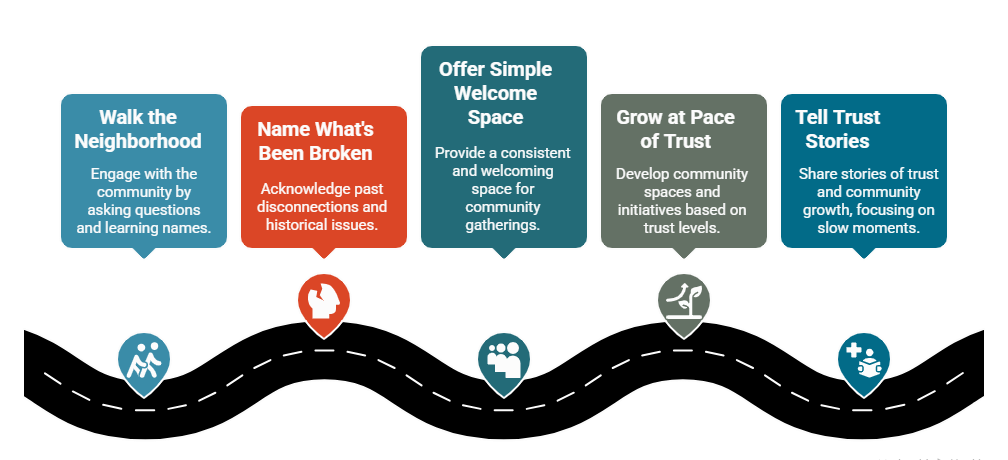
5 Steps to Rebuild Trust
-
- Walk the neighborhood
Not with answers—just with time. Ask questions. Learn names. Linger longer. - Name what’s been broken
Acknowledge the disconnection. Don’t skip the history. - Offer one simple, consistent space of welcome
A monthly meal. A porch prayer. A Friday night hangout. Keep it small. Keep it faithful. - Let your building grow at the pace of trust
Don’t renovate for people who haven’t walked through the door yet. Build what trust invites. - Tell trust stories, not just success ones
Celebrate slow, Spirit-led moments. A neighbor who came back. A teenager who stayed.
- Walk the neighborhood
Final Reflection / Call to Action
Not every church needs a bigger building. But every community is hungry for something real. And sometimes, the most Spirit-filled thing we can do is just walk next door.
This isn’t a story about strategy. It’s a story about staying long enough for trust to grow again.
If you’re ready to listen to your neighborhood in a new way, start here:
If you’re wondering what this could look like in your community, you don’t have to figure it out alone.
- Download the Community Mapping Playbook to serve your context
- Book a 20-minute call with our team to discern next steps
Source: Learn more